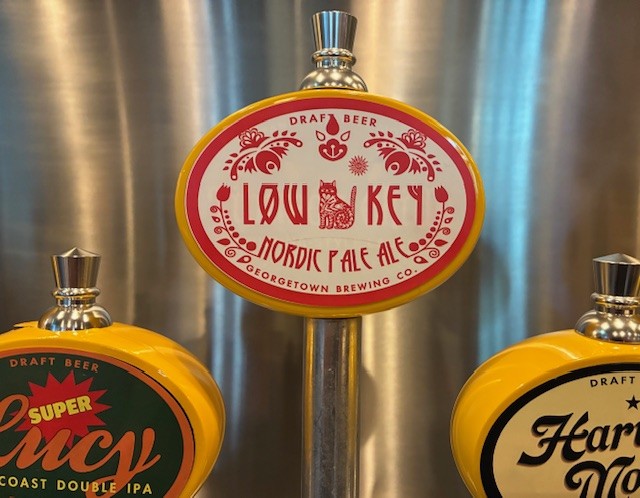

For decades, brewers have associated clean lager-style fermentation with extended conditioning periods and tightly controlled cold fermentation schedules.
But what happens when a multi-strain kveik culture is fermented under traditional lager temperatures?
In this trial, we explored the low-temperature performance of K.22 Stalljen Multi-Strain Kveik in a pale lager-inspired brewing process.
The objective was straightforward:
Evaluate fermentation performance, clarity and process efficiency during low-temperature fermentation.
Fermenting Kveik at Lager Temperatures
K.22 Stalljen is known for its broad operating range and controlled fermentation profile.
While many brewers associate kveik with warm fermentation, Stalljen can also perform at significantly lower temperatures. In this trial, fermentation was conducted at 12°C for four days before increasing the temperature to 18°C on day five.
The result was a complete fermentation cycle within one week.
Rather than relying on extended maturation periods, the focus was on efficient fermentation management and process control.
Brewing Parameters
Grain Bill
- Bonsak Fairytale Pilsner Malt — 86%
- Bonsak Munich Malt — 7%
- Stangeland Mølle Flaked Oats — 7%
Hop Schedule
- Magnum (60 min) — 14.3 IBU
- Saaz (25 min) — 11.4 IBU
Yeast
- K.22 Stalljen Multi-Strain Kveik
- Pitch Rate: 60 g/hL
Water Profile
Adjusted to a traditional German-style pilsner profile:
- Calcium: ~50 ppm
- Sulfate: ~60 ppm
- Chloride: ~60 ppm
Process Overview
Mash
Double decoction mash
- 90 minutes
- 65°C
- pH 5.3
Boil
- 90 minutes
Fermentation
- 12°C for 4 days
- Raised to 18°C on day 5
Clarification
The beer was treated with Brewers Clarex and cold crashed after fermentation.
No extended lagering period was used.
Observations
Fermentation Performance
The culture completed fermentation rapidly despite the low temperature.
Clarity
Following cold crashing and clarification, the beer achieved excellent visual clarity without prolonged conditioning.
Production Implications
For breweries exploring low-temperature fermentation workflows, cultures capable of maintaining performance across a broad temperature range may offer additional production flexibility.
Potential benefits include:
- Faster tank turnover
- Reduced conditioning requirements
- Greater scheduling flexibility
- Simplified fermentation management
Why This Matters
Kveik is often discussed in the context of warm fermentation.
However, trials like this demonstrate that certain multi-strain cultures can also perform effectively under significantly cooler fermentation conditions.
Understanding how fermentation cultures behave across different temperature ranges gives brewers more options when designing production workflows.
In the end, the most interesting result was not the recipe itself.
It was how little the fermentation process demanded from the brewer.
The culture simply got on with the job.